
← Part of the CPAP & GLP-1 Adjustment Hub
Waking Up Bloated on CPAP? Understanding Aerophagia
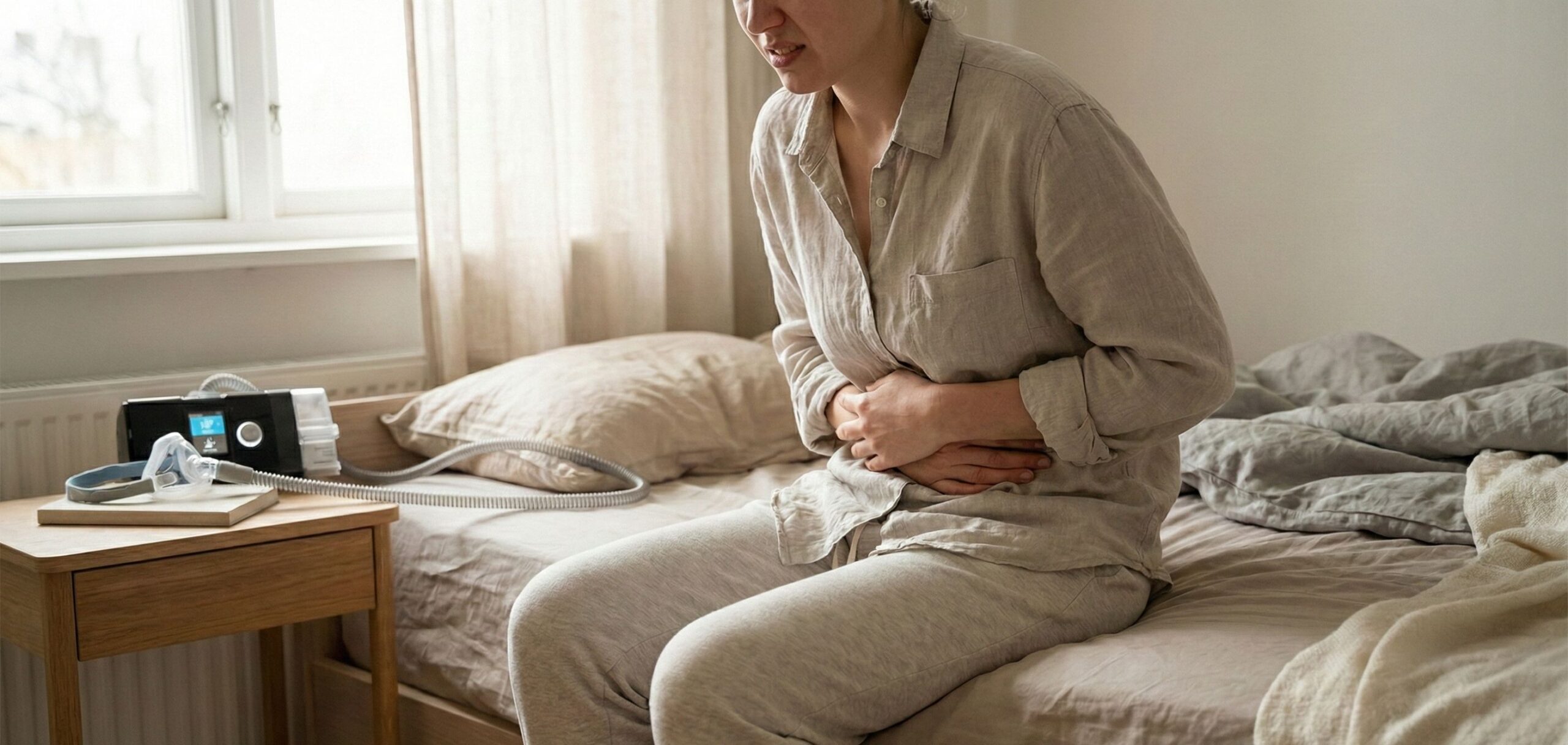
If you feel like you’ve swallowed a beach ball by 6:00 AM, you are experiencing a phenomenon called CPAP Aerophagia (literally “air swallowing”). It is painful, confusing, and one of the most common reasons people quit therapy.
For patients on GLP-1 medications, this issue is doubly frustrating. You are losing weight to get healthy, yet you find yourself waking up bloated on CPAP more often than when you were heavier. Why is success making you feel worse?
The Physics of the “Wrong Turn”
Your throat has two pipes: the trachea (to the lungs) and the esophagus (to the stomach). Normally, CPAP pressure holds the airway open just enough to let air flow into a the lungs.
However, as you lose weight, the fat deposits that used to crowd your throat disappear. Your airway becomes clearer and wider. If your machine is still pumping air at the high pressure required for your “old” body, that air no longer meets resistance in the trachea. Instead, it takes the path of least resistance: blowing past the Upper Esophageal Sphincter (UES) and inflating your stomach all night long.
Why GLP-1s Make It Worse
Medications like Wegovy and Ozempic add a second layer to this problem. They work by slowing down gastric emptying to keep you full. When you force high-pressure air into a stomach that is chemically “slow” and already full of yesterday’s food, the pressure builds rapidly.
This is why waking up bloated on CPAP is often the first sign that you have hit a major weight loss milestone. Your body is telling you that your “prescription” is now too strong for your anatomy.
3 Quick Fixes to Try Tonight
- The Chin Tuck: If your chin drops to your chest, it can open the esophagus. Use a soft cervical collar to keep your head neutral.
- Check Exhalation Relief: Turn on your machine’s EPR (ResMed) or Flex (Respironics) setting. This lowers the pressure when you exhale, reducing the amount of air forced into the stomach.
- Sleep on an Incline: Elevating your head with a wedge pillow makes it physically harder for air to travel “downhill” into the stomach.
Related: Learn the symptoms of high CPAP pressure.